This is all from the last 24 hours
Yemeni Rebels Kill 12 Soldiers, Injure 55, Kidnap 228 in Series of Attacks Bloomberg
Is Yemen in the Middle of Another Undeclared War? TIME
Houthi Ceasefire Holds, Yemen Says UPI
Yemen: President Makes Offer to Rebels NY Times
and the follow-up,
Yemen President Accuses Rebels of Rejecting Peace AFP
Yemen Claims to Form 12,000 Strong Army in Southern Yemen Xinhua - this is influenced by a Hadith attributed to Mohammed that, at some point in the future, an army of 12,000 would come out of southern Yemen. But to be honest, AQAP's chances of raising an army of 12,000 (when their current numbers are around 200) is on par with their attempt to HARNESS THE POWER OF LIGHTNING! No, that's not a real thing, but it has just as much chance of happening. When Iraq invaded Kuwait back in the day, bin Laden made a similar claim to the Saudi defense minister:
[Bin Laden:] I am ready to prepare 100,000 fighters with good combat capability within three months. You don't need Americans. You don't need any other non-Muslim troops. We will be enough.
[Prince Sultan:] There are no caves in Kuwait. What will you do when he lobs missiles at you with chemical and biological weapons?
[Bin Laden:] We will fight him with faith.
I can only imagine Prince Sultan sitting through this with an arched eyebrow and ending the meeting with a "don't call us, we'll call you!"
Saturday, July 31, 2010
Friday, July 30, 2010
Sana'a Zoo

It was one of my friend's last days in Yemen and he decided to go out with a bang. After spending the morning driving out to the edge of the city to have his photo taken on a motorcycle while holding a Kalashnikov in the air with a hunting falcon on his shoulder, he wanted to go to the city zoo. 'Interesting' is the best word to describe the place. As we walked up to the gates I felt some trepidation as zoos outside America and Europe tend to be depressing enough to warrant Prozac dispensers and lithium milkshakes within the grounds. As Yemen's national zoo goes it certainly isn't the worst out there but it's still enough to make one go 'awww' and cringe inside as another piece of innocence is taken away with the laughing wind.

It being Friday, the last day of the weekend and the big religious day of the week, it was family day at the zoo. However, we were informed that, unlike back home where family day means you get a discount when you bring the kids, in Yemen family day means only families are allowed in. Our Somali friend that we sent to the ticket window (to avoid getting the extra 'white foreigner' charge) was sent away because 'he wasn't with any women'. We sent up one of our own next who just said, 'Yeah, I'm here with my family'. Our group of four guys was given a surly look by the guard taking the tickets as we played the 'I'm an American who doesn't speak your demon-tongue' game immortalized by our tourists worldwide, thus avoiding his questions about the location of our women.

The zoo actually had an impressive collection of animals that you rarely see in captivity (because they generally do... poorly when confined). Hyenas, mongeese, honey badgers, baboons, and several very rare wildcats native to the Arabian Peninsula. There were a few other species of animals divided into what must be universally-followed zoo sections: tame animals, birds, wild animals and monkeys. Among all the mammals was the obsessive-compulsive behavior you find in caged animals: some lions would rub their head along the length of fence and back; a hyena would run to one side of its cage, rub its neck up the wall as high as it could go on its hindlegs, then run to the other side and do likewise, repeating this pattern indefinitely; a mongoose zipped around its cage in an X, pausing every 10 seconds to look out of the same bars. It's behavior that you never see in the wild and only very rarely see in a US zoo, but here it was just everywhere except among the cage of fat-tailed sheep, who just seemed happy they weren't going to get eaten any time soon (the name comes from their fatty tail, which is the size of a large human palm; it's a delicacy I haven't been able to find yet)

It was pointed out to me by a friend that in the Middle East (and much of the world in general) there are no anthropomorphic cartoons for children. No Mickey Mouse, Bugs Bunny or Simba, no sympathetic characters that make you go "NO! They got Bambi's mom!" Animals are rarely pets and often a food source. Each day you run into the butcher's shop to order some fresh chicken or lamb. Dogs and cats are stray animals that pick through the trash and carry disease. It's the opposite of the US, where pet ownership is ubiquitous, animals rights are fairly mainstream and where we have very well-publicized societies of loons who are well-off enough to tell us to 'Save the Sea Kittens!' ('Sea Kitten' is socially maladjusted speak for 'fish')

Thursday, July 29, 2010
About the Latest Yemenews...
To add a note about how the recent violence has affected the capital, there haven't been big, overt signs of imminent danger. The soldiers sitting guard in their little booths along the street still seem languid and their cheeks are, as always, full of qat. The government still allows the Ajnabi (foreigners) outside the city and around the same sections of the country they always have.
But that aside, the reserves have been steadily called up; one of our guards was recently called back to duty. The sound of jets taking of from Sana'a International (yes, the commercial airport is also the capital's only air force base - the MiGs use the same runway as the Airbuses) has definitely increased. The latest truce with the Houthis (the 6th, I want to say) looks like it will dissolve and lead to the seventh war against the northern rebels. The southern secessionists are growing loud and, in the case of the government's resumption of hostilities with the rebels it's possible that they'd do their best to stage the biggest uprising of which they're capable, which could be large or small, no one knows (North and South Yemen were united in 1990, then separated in 1994, and after a short civil war rejoined that same year). Al-Qa'eda is also playing an active role, with several recent attacks on curiously unguarded government facilities (in a country with over 3 guns per person, how is it possible to have a police station with no armed guards?).
Yemen's never boring.
But that aside, the reserves have been steadily called up; one of our guards was recently called back to duty. The sound of jets taking of from Sana'a International (yes, the commercial airport is also the capital's only air force base - the MiGs use the same runway as the Airbuses) has definitely increased. The latest truce with the Houthis (the 6th, I want to say) looks like it will dissolve and lead to the seventh war against the northern rebels. The southern secessionists are growing loud and, in the case of the government's resumption of hostilities with the rebels it's possible that they'd do their best to stage the biggest uprising of which they're capable, which could be large or small, no one knows (North and South Yemen were united in 1990, then separated in 1994, and after a short civil war rejoined that same year). Al-Qa'eda is also playing an active role, with several recent attacks on curiously unguarded government facilities (in a country with over 3 guns per person, how is it possible to have a police station with no armed guards?).
Yemen's never boring.
Yemenews: Rebels, Separatists and al-Qa'eda Edition
Will attempt to update with a handful of posts tomorrow if the electricity cooperates. For now, here's a collection of news reports on the recent uptick in violence throughout the country.
Yemen Smolders Amid Houthi Insurgency and Al Qaeda Attacks L.A. Times
Yemen's Separatists Call for Southern Uprising VOA News
Yemen: Fighting Intensifies Between Rebels and Government NY Times
In Yemen, Violent Confrontations Between Tribes and Rebels Le Monde (French)
Yemen Clashes Reflect North-South Tensions NY Times
'Al Qaeda' Ambushes Yemeni Soldiers Al Jazeera
Houthi Rebels Take 'Yemen Army Position' BBC
US Turns up Head on Internet Imam Awlaki NPR
Yemen Smolders Amid Houthi Insurgency and Al Qaeda Attacks L.A. Times
Yemen's Separatists Call for Southern Uprising VOA News
Yemen: Fighting Intensifies Between Rebels and Government NY Times
In Yemen, Violent Confrontations Between Tribes and Rebels Le Monde (French)
Yemen Clashes Reflect North-South Tensions NY Times
'Al Qaeda' Ambushes Yemeni Soldiers Al Jazeera
Houthi Rebels Take 'Yemen Army Position' BBC
US Turns up Head on Internet Imam Awlaki NPR
Tuesday, July 20, 2010
Kamaran Pics
Got the pictures working. The post will come later but for now here are some shots of Kamaran.

Yes, those are whale bones. Where did they get them? Didn't want to know.


My room


Grand Mosque of Sana'a
My posting has recently been late and rare. I'm currently in a class with two Europeans, a Dane and a German, with a greater breadth of Arabic than myself, and I've been consumed by work in the language - that, plus four contiguous hours of class a day plus trekking out to the gym leaves little time to blog for the benefit of my mother and those stumbling on this page from misspelled Google searches. Anyway...
Today we made a visit to the Grand Mosque of Sana'a. At 1,400 years old it's one of the oldest mosques in the world; in fact, it's generally placed as the third oldest. As a widely-followed rule, non-Muslims are barred from entering mosques, but we were able to visit the sections of the mosque that are currently being renovated (they started several years ago and think they'll be finished by 2014). In the first section we were in the first thing I noticed was the pit dug in the ground; small sections of the mosque have been given the green light for archeological digs down, down, down to the original floor of the building about 12 feet down. As time has gone by and the land changed, the mosque's floor has crept up centimeters at a time. The side of the hole had dozens of lines, over a hundred distinct levels as the floor slowly grew closer to the carved wood of the ceiling - if the pattern continues, in one or two hundred years even the diminutive Yemenis will have to stoop under the arches connecting the room's columns.
The mosque is also old enough that, squirreled away in the walls and the ceiling, wooden blocks with carvings of animals and even people were found (images of people and animals are generally frowned upon in Islam) in addition to the discovery of old versions of the Qur'an that were kept hidden by the mosque's keepers for some time; much like the Bible, the Qur'an went through several revisions and variations in the early years until a universal version was established. Such early versions are very rare and clergy approach them with trepidation - they cannot be destroyed as they are part of the holy Qur'an but they definitely can't just be left lying around or, even worse, disseminated. Thus, centuries upon centuries ago, some enterprising people stuffed the manuscripts into a space between the ceiling and the roof, much like they placed the wooden animal carvings behind niches and inside walls in the hope that ages of neglect will solve their catch-22.
There are no pictures as they weren't allowed - there are future publications envisioned by the archaeologist in charge and his cohort of helpers, and photos of the work in progress would put a damper on the surprises of any papers. And I'm trying to post an entry on the Island of Kamaran in the Red Sea but my camera's deciding that it would rather not transfer its photos.
Today we made a visit to the Grand Mosque of Sana'a. At 1,400 years old it's one of the oldest mosques in the world; in fact, it's generally placed as the third oldest. As a widely-followed rule, non-Muslims are barred from entering mosques, but we were able to visit the sections of the mosque that are currently being renovated (they started several years ago and think they'll be finished by 2014). In the first section we were in the first thing I noticed was the pit dug in the ground; small sections of the mosque have been given the green light for archeological digs down, down, down to the original floor of the building about 12 feet down. As time has gone by and the land changed, the mosque's floor has crept up centimeters at a time. The side of the hole had dozens of lines, over a hundred distinct levels as the floor slowly grew closer to the carved wood of the ceiling - if the pattern continues, in one or two hundred years even the diminutive Yemenis will have to stoop under the arches connecting the room's columns.
The mosque is also old enough that, squirreled away in the walls and the ceiling, wooden blocks with carvings of animals and even people were found (images of people and animals are generally frowned upon in Islam) in addition to the discovery of old versions of the Qur'an that were kept hidden by the mosque's keepers for some time; much like the Bible, the Qur'an went through several revisions and variations in the early years until a universal version was established. Such early versions are very rare and clergy approach them with trepidation - they cannot be destroyed as they are part of the holy Qur'an but they definitely can't just be left lying around or, even worse, disseminated. Thus, centuries upon centuries ago, some enterprising people stuffed the manuscripts into a space between the ceiling and the roof, much like they placed the wooden animal carvings behind niches and inside walls in the hope that ages of neglect will solve their catch-22.
There are no pictures as they weren't allowed - there are future publications envisioned by the archaeologist in charge and his cohort of helpers, and photos of the work in progress would put a damper on the surprises of any papers. And I'm trying to post an entry on the Island of Kamaran in the Red Sea but my camera's deciding that it would rather not transfer its photos.
Wednesday, July 14, 2010
Another Dose of Yemenews
Sorry that it's been a while. Power outages have been getting more frequent and the rainy season's started, meaning that it rains for most of the day every day, and in a city with no sewer system the streets flood very, very fast and cause a lot of electrical shorts. Here's another roundup of Yemen news and I should post pictures of my visit to Kamaran, an island in the Red Sea, later.
The Growing Power of Al-Qaida in Yemen
Yemen intelligence office attacked
Security Brief: al Qaeda's new glossy
Is Yemen the Next Afghanistan?... I don't know, is the New York Times the next National Enquirer? A good article with one of the dumbest titles I've ever seen.
Yemeni Demonstrators Killed in Clashes with Police - more unrest in the South. The government's been calling up all its reserves recently, so there's a pretty good chance something big will happen soon.
The Growing Power of Al-Qaida in Yemen
Yemen intelligence office attacked
Security Brief: al Qaeda's new glossy
Is Yemen the Next Afghanistan?... I don't know, is the New York Times the next National Enquirer? A good article with one of the dumbest titles I've ever seen.
Yemeni Demonstrators Killed in Clashes with Police - more unrest in the South. The government's been calling up all its reserves recently, so there's a pretty good chance something big will happen soon.
Thursday, July 1, 2010
Cairo Castle

Cairo literally means 'the Conquerer', and Qalat al-Qahra, Castle of the Conquerer, is perched on a high roost overlooking the city of Ta'izz; as the centuries have passed its stone has gradually enveloped more and more of the hill it was built upon. We drove up until we reached its lower walls, and from there it was a hike to the keep. The fort still functions as a military base in case of Southern unrest, as Yemen is one of the few remaining countries where a castle is still an insurmountable redoubt.


Ibb, Jibla

Apologies for taking a while to put this up - I got sick from something I ate (and since this is Yemen, it could have been anything I ate) and have been under the weather. But here goes...
We set out from Sana'a Thursday morning, driving southwest through the mountains ringing the capital for hours, stopping once for a break at a police outpost on a cliffside, the bathroom of which was the disgusting wrongness of Hell given physical form. After four hours of driving, we rolled into the southern city of Ibb and ate lunch on the floor of a restaurant that, for reasons left unknown, had been swathed in astroturf. As we were ajnabi (foreigners), the waiter immediately carried out an armload of Cokes, because that's what Westerners drink, of course.

Ibb was the seat of an emirate until 1944 when it was enfolded into Yemen, and among the older men at least it seemed there is still some resentment of Yemeni authority, and especially distrust of foreigners - we got more stares than usual and as we were leaving an old men with henna in his beard (generally a bad sign for Westerners - dying one's hair with henna is traditional when a conservative man reaches a certain old age, and it often dovetails nicely with xenophobia) came up to our bus yelling. He was nearly impossible to understand with a cheek full of qat, and as he screamed something about the CIA, Iraq, and foreign dogs, masticated qat saucers hummed out of his mouth.

After pulling away from the out-of-his-mind-high septuagenarian, we drove a few miles into the hills of Ibb to the town of Jibla. The hillside town was mostly built up centuries ago by Queen Arwa, who ruled until she died at the age of 92. We made a stop at her mosque and, in a nice change, were allowed inside (generally non-Muslims aren't allowed inside mosques, but this rule really depends on the liberalism or conservatism of the area and the local congregation). On the downhill, cobble-stoned walk back to our bus we experienced the light drizzle of our first rain in Yemen.

Saturday, June 26, 2010
Pics
Just got back from the 3-day trip. I'm too tired to write anything so for now I'll just post some pictures.


Wednesday, June 23, 2010

Traveling this Weekend
Tomorrow I'm heading out with a group from my school for a three-day trip in southeast Yemen. We're visiting the cities Ibb, Jiblah, Ta'izz (the old capital of the imamate), al-Khoukha (with swimming in the Red Sea), al-Makha (you can thank this city for the coffee you drink, though nowadays its only contribution to the coffee trade is the Anglicization of its name: Mocha) and Zabid. I'll do my best to write a post or two tonight, but there's a very real chance we'll lose power. If that's the case, look out for posts and pictures about my trip Saturday afternoon.
Right now I have to go buy some qat for the 4-hour busride (and that's assuming we make good time - paved roads here are rarer than foreigners) and a mowaz or two - they're essentially man-skirts. The weather in the south this time of year is around 115 degrees and it's very, very humid... Bluejeans aren't gonna cut it this time.
Right now I have to go buy some qat for the 4-hour busride (and that's assuming we make good time - paved roads here are rarer than foreigners) and a mowaz or two - they're essentially man-skirts. The weather in the south this time of year is around 115 degrees and it's very, very humid... Bluejeans aren't gonna cut it this time.
More Yemenews
Here's another roundup of what the news says is happening in Yemen
Socotra: The Other Galapagos Awaits Tourists
British Student Held in Prison with al-Qa'eda Members
Yemen Arrests Suspected Mastermind Behind Sana'a Jailbreak
3 Yemeni Soldiers Die in Clashes in the South
After Yemen Holiday American in Limbo - interesting sidenote; one of the students here knows Yahya - he met him in Cairo last month
Foreigners Held in Yemen Crackdown
Socotra: The Other Galapagos Awaits Tourists
British Student Held in Prison with al-Qa'eda Members
Yemen Arrests Suspected Mastermind Behind Sana'a Jailbreak
3 Yemeni Soldiers Die in Clashes in the South
After Yemen Holiday American in Limbo - interesting sidenote; one of the students here knows Yahya - he met him in Cairo last month
Foreigners Held in Yemen Crackdown
Thursday, June 17, 2010
Day Trippin'

Today was the first trip outside the city. To leave, one needs advance permission from the Department of the Interior as well as documentation for everywhere you're going and when you should get there. This information was checked multiple times along the road as the soldiers at each station counted how many foreigners were in the car. For example, if that morning one of us had gotten sick and couldn't make the trip, none of us would have made it out the city. The Yemeni government keeps close tabs on Westerners from the dual fears of a) I hope these aren't more radical idiots trying to slip away to the Houthis or al-Qa'eda and b) if anything happens to foreigners that's another huge drop in tourism and a lot more pressure from foreign governments. So suffice to say, a van full of white people attracts special military attention, though surprisingly we didn't have an escort - some of the people in the program now were studying Arabic at the same college in 2008 and their trip to Kowkaban involved two jeeps with mounted .50-cal machine guns that went everywhere with them.
We first stopped at an outcrop overlooking Wadi Dhahr, a valley filled with qat trees and one of the imam's old summer palaces. There was a man with a hunting falcon available for pictures, and I almost cracked even with his outrageous price. I had to slowly think "patience, patience, you'll have your chance... every old man outside Sana'a worth his weight in qat has a hunting falcon."

From there it was on to the walled town of Thula. Our minibus pulled into the main square right in time for us to hop out and watch a Jambiya Dance in a crowd of Yemenis packing a whole lot of heat. The dance went on for some time while the man I assume was the groom stood on the side with an expression that seemed to say "I am displeased with your offering". In very skilled Jambiya Dances the moves are so tightly choreographed that the smallest error can result with a jambiya in your kidney. These guys were more free-flow, utilizing known moves while improvising and pulling in as many foreigners as they could. And yes, I went through some effort to 'blend in' with the 5' 8" Yemenis and thus avoid the dance.


We ate lunch in Shibam in the same dining room as the governor of the province, who gave us honey bread from his own table and, on the way out, told us in Arabic "peace upon Obama". Needless to say, I don't think he was a Hill-dawg fan. So next time I run into Barack, I'll pass on the message. We also passed a 10-year-old on the stairs with his...
a) Sesame Street ball
b) puppy, Mr. Flufflepaws
or
c) a late-model Kalashnikov
If you don't know the answer at this point, thanks for being like the other 7 billion people out there and not reading anything I write.

It took a long, long time to hike up the side of Kowkaban, and it was pretty obvious why it was such a key spot for a fortress. Any invading army would have to make their way up hundreds upon hundreds of meters only to get to a walled city with its own spring. Only fools ever thought "hey, I bet I can capture Kowkaban today". The city itself was partially rebuilt from heavy bombing it experienced when it confronted its first enemy with an airforce. The view was amazing off the side of this Masada-like rock, although I nearly murdered someone when I realized I could have caught a ride with our minibus on the road that leads right to the city gates rather than spending an hour huffing and puffing up endless staircases and goat herds.

I'm attempting to post huge swathes of photos from the summer online - it's a little problematic since the Internet here isn't exactly a workhorse. When I get it working I'll post a link with the pics I've taken so far from Geneva, Oxford, London, Sana'a, Thula, Shibam and Kowkaban.
The Sheraton
The book Imperial Life in the Emerald City by Rajiv Chandrasekaran contains an account of Baghdad's Green Zone in the immediate aftermath of the US invasion: while the dusty streets of the city were filled with gunfire, sectarian bloodshed, chaos, inside the Green Zone wealthy young contractors sat by the poolside sipping beers while others grilled hotdogs, with a classic rock soundtrack played through loudspeakers. It was a condensation of Americana in the heart of an alien culture, totally disconnected from the metropolis outside. That's what the Sheraton is like.
Yesterday was one of my classmates' birthdays, and so a group of us decided to head to the Sheraton in Sana'a, one of the few places in town that serves beer. At 9 we hopped in a cab and drove to the other side of town. It holds the fragments of Western culture in Sana'a: the US embassy, the Sheraton and Movenpick hotels, and Tourist City, a compound for expats that requires a non-Yemeni passport for entry. Our cab pulls up to the outer wall of the Sheraton and we're greeted by heavily-armed soldiers and a barricade. The undercarriage, engine block and trunk of the car were checked and the taxi driver was patted down and questioned, all while us ignored foreigners shifted around uncomfortably. We were finally cleared and drove on to the second guarded checkpoint, and then onto the hotel itself.
It was eerily empty. We walked through the metal detectors into the marble lobby; the only other people we saw were bored-looking staff in red porter outfits. We walked downstairs to find an honest-to-goodness Chinese restaurant where we ate Western-priced dumplings. Sitting at a table with a cloth napkin and seeing my first fork in weeks was odd. The large dining room was home to an American oilman smoking and staring blankly at a Chinese watercolor, and a well-padded American couple who looked like they wouldn't venture outside the Sheraton bubble during their stay yet would still proudly claim to their friends back home that they visited Sana'a, "even though it's pretty dangerous". We finished eating and headed upstairs to the bar. Outside was a foam cow skull, some cactus and a sign advertising a cowboy-style event that weekend. Inside was a dim room with red, velvety wallpaper covered with dozens of pictures of New York landmarks: buildings, Broadway marquees, taxis. The bar's patrons all looked like Saudis, and they were throwing down massive amounts of cash for the hard-to-find alcohol; a double of Johnnie Walker Red ran around $20. We played pool for a while on worn tables with mis-matched balls and then called it a night. At the lobby we asked if we could get a taxi and, within seconds we had the Sheraton Mercedes at our disposal, paying the equivalent of $8 for the ride home (the average Yemeni takes three days to earn that much). The car was out-of-place: new, washed, without even a ding or scratch. We felt amazingly conspicuous riding in the German beast back to our dorm.
Without a doubt, the night at the Sheraton was the most alien experience I've had in Yemen. This compound of opulence surrounded by beggars who have to drag themselves around because they can't afford a wheelchair for the legs they lost in the civil war. Riding home in a freshly waxed Mercedes-Benz while women outside the window were picking through the trash. I value the trip for the experience, but it's not a positive memory.
Yesterday was one of my classmates' birthdays, and so a group of us decided to head to the Sheraton in Sana'a, one of the few places in town that serves beer. At 9 we hopped in a cab and drove to the other side of town. It holds the fragments of Western culture in Sana'a: the US embassy, the Sheraton and Movenpick hotels, and Tourist City, a compound for expats that requires a non-Yemeni passport for entry. Our cab pulls up to the outer wall of the Sheraton and we're greeted by heavily-armed soldiers and a barricade. The undercarriage, engine block and trunk of the car were checked and the taxi driver was patted down and questioned, all while us ignored foreigners shifted around uncomfortably. We were finally cleared and drove on to the second guarded checkpoint, and then onto the hotel itself.
It was eerily empty. We walked through the metal detectors into the marble lobby; the only other people we saw were bored-looking staff in red porter outfits. We walked downstairs to find an honest-to-goodness Chinese restaurant where we ate Western-priced dumplings. Sitting at a table with a cloth napkin and seeing my first fork in weeks was odd. The large dining room was home to an American oilman smoking and staring blankly at a Chinese watercolor, and a well-padded American couple who looked like they wouldn't venture outside the Sheraton bubble during their stay yet would still proudly claim to their friends back home that they visited Sana'a, "even though it's pretty dangerous". We finished eating and headed upstairs to the bar. Outside was a foam cow skull, some cactus and a sign advertising a cowboy-style event that weekend. Inside was a dim room with red, velvety wallpaper covered with dozens of pictures of New York landmarks: buildings, Broadway marquees, taxis. The bar's patrons all looked like Saudis, and they were throwing down massive amounts of cash for the hard-to-find alcohol; a double of Johnnie Walker Red ran around $20. We played pool for a while on worn tables with mis-matched balls and then called it a night. At the lobby we asked if we could get a taxi and, within seconds we had the Sheraton Mercedes at our disposal, paying the equivalent of $8 for the ride home (the average Yemeni takes three days to earn that much). The car was out-of-place: new, washed, without even a ding or scratch. We felt amazingly conspicuous riding in the German beast back to our dorm.
Without a doubt, the night at the Sheraton was the most alien experience I've had in Yemen. This compound of opulence surrounded by beggars who have to drag themselves around because they can't afford a wheelchair for the legs they lost in the civil war. Riding home in a freshly waxed Mercedes-Benz while women outside the window were picking through the trash. I value the trip for the experience, but it's not a positive memory.
Monday, June 14, 2010

Dubabs
Sana'a is a city of 2 million where the average income is about $800 a year. So what most people need is a dirt-cheap way to get around a large city. The dubabs fill that role.
Dubabs are very, very small minibuses (none of that was redundant - just look at the picture below). They follow a set route between A and B and you simply wave one down and tell the driver to pull over when you reach your stop. Each ride costs YR 30 (about 10 cents) and each dubab seats about 9 people (again, look at the picture). The route is advertised by a number on a color background because of high illiteracy rate. I've only taken a few rides so far because I usually end up wedged between two Yemenis who try talking to me with their cheeks full of qat. All I can do is nod and say "I don't understand" in Arabic, but that hasn't stopped a Yemeni talking yet - indeed, my knowledge of an Arabic word makes them talk more and faster.

This is a very nice dubab. It doesn't have any holes in the floor and it still has all its doors.
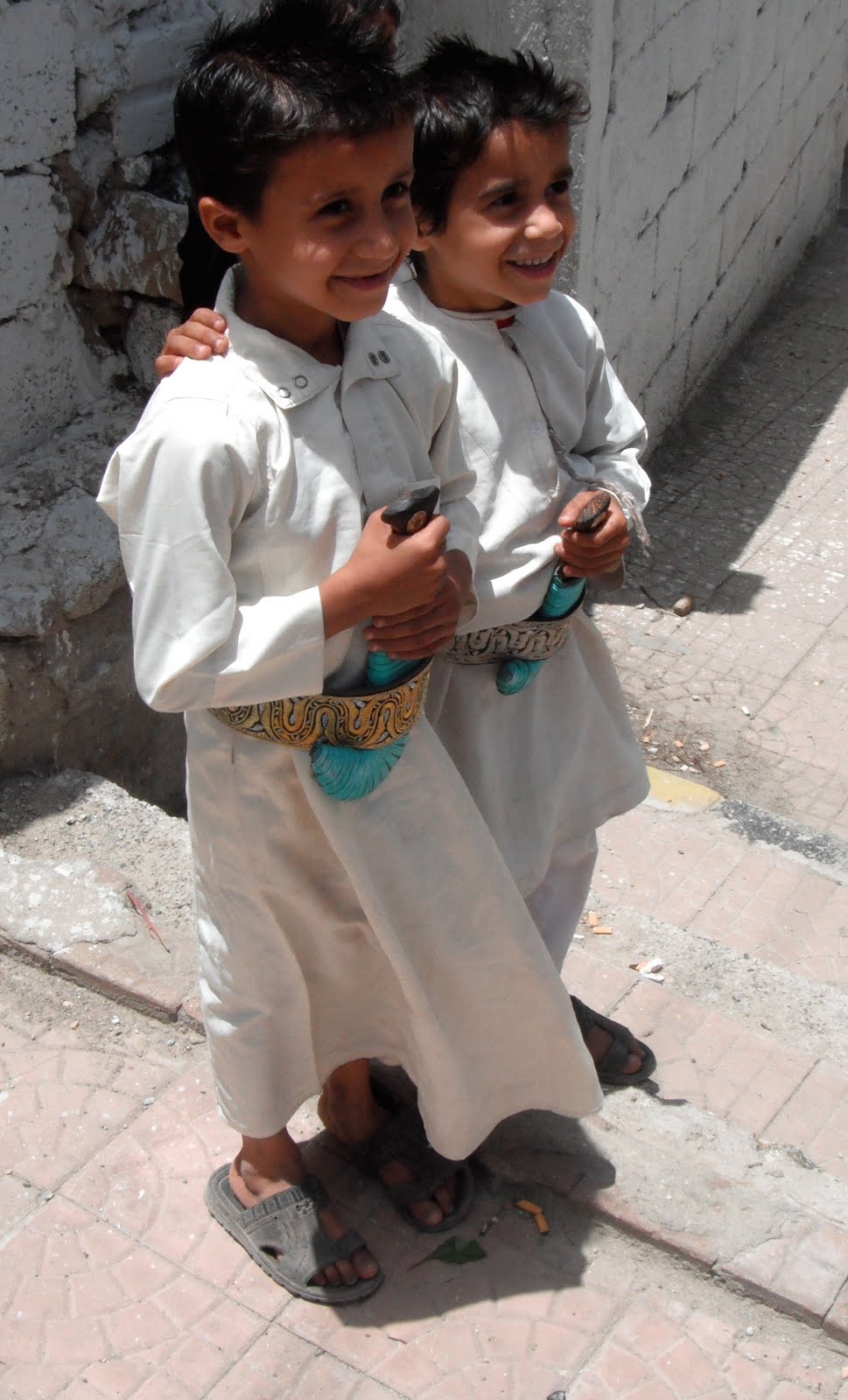
In a city without lanes, street signs, stop lights or traffic laws, the dubabs are known for driving more recklessly than anything else on the road, which is especially disconcerting when you're in the seat closest to the missing door. Seat belts are nonexistent because they're considered too 'effeminate' - some other things considered effeminate are teeth-brushing and working out, because such concern over what you look like is apparently just unmanly; then again, in a culture where brandishing your dagger and Kalashnikov on the street is the norm, just about everything seems 'unmanly'.
Dubabs are very, very small minibuses (none of that was redundant - just look at the picture below). They follow a set route between A and B and you simply wave one down and tell the driver to pull over when you reach your stop. Each ride costs YR 30 (about 10 cents) and each dubab seats about 9 people (again, look at the picture). The route is advertised by a number on a color background because of high illiteracy rate. I've only taken a few rides so far because I usually end up wedged between two Yemenis who try talking to me with their cheeks full of qat. All I can do is nod and say "I don't understand" in Arabic, but that hasn't stopped a Yemeni talking yet - indeed, my knowledge of an Arabic word makes them talk more and faster.

In a city without lanes, street signs, stop lights or traffic laws, the dubabs are known for driving more recklessly than anything else on the road, which is especially disconcerting when you're in the seat closest to the missing door. Seat belts are nonexistent because they're considered too 'effeminate' - some other things considered effeminate are teeth-brushing and working out, because such concern over what you look like is apparently just unmanly; then again, in a culture where brandishing your dagger and Kalashnikov on the street is the norm, just about everything seems 'unmanly'.
New Format
Since my days usually consist of studying Arabic in class and studying Arabic outside of class, from now on I'm going to post a few times a week on specific facets of Yemeni culture and institutions rather than provide a repetitive narrative of my day-in day-out studies.

The Saleh Mosque at dusk; it seats 40,000


Friday, June 11, 2010
Qat Chew
So I may have dropped the ball over the last week; but let's face it, I'm in a new city wading through a language that makes the Labyrinth look like a McDonald's Playzone. Since it's late and I have an early get-up for class (the Yemeni weekend is Thursday and Friday) I'll post about the last two days rather than the entire week.
After another four grueling hours in morning classes on Thursday (we had class to make it up for lost time waiting for everyone to get it) it was time for the school-sponsored activity I was most curious about: lunch followed by a qat chew with teachers and staff. But Jo, what's qat?... I'll get to that.
After class about 8 of us hopped in the back of the school's pickup truck. Driving through the dusty, chaotic streets we made quite a scene - even before the troubles, foreigners were rare, and nowadays with the almost nonexistence of tourists, a truckload of white kids rolling through downtown was pretty conspicuous. If I had 50 riyals for every double-take I saw, I'd have a good $4 (that's a wad of riyals we're talking about). Drivers behind us would honk and wave or pull up alongside us to talk and Yemenis on the street, once they were convinced they weren't hallucinating, broke out smiles and shouts of "Amrika!" and "Welcome to Yemen!" with healthy doses of thumbs-up.
We walked en masse into a salta restaurant and grabbed seats on the floor for our low-set table. The restaurant staff brought out salta - large pots of a gooey mix of meat, spices and local vegetables that's cooked on top of blue flames in a furnace. They held these cast-iron pots, which when right off the flames could easily put you in the burn ward, with chunks of scavenged cardboard. Food is communal in Yemen and utensils are something only used by outsiders; salta is eaten by scooping it up with thin slices of bread (much like naan) and everything is shared with the others at the table; if you show up alone to a restaurant be prepared to share with total strangers. After the meal we gave one of our teachers money for him to take to the qat market while we rode back to my dormitory, which has the best mafraj of the college, a mafraj being a room on the top floor of a building that's either open-air or well-endowed with windows and lined with pillows and floor couches.
So you have some background on qat: the leaves from the qat plant are filled with chemicals that act as a stimulant (at its strongest it's been compared to Speed). Yemen is the largest producer and consumer of qat, though the plant is popular in several East African countries as well, Somalia especially. Qat's legality wholly depends on the country you're in; in the US it's a Schedule 1 (ie, like heroin, methamphetamine, etc), in the UK it's legal, and in Saudia Arabia its possession carries harsh penalties, even by Saudi standards. However, since qat use is constrained in the US to Yemeni and Somali immigrants, it's doubtful that a police officer would even know what qat was, much less that it was illegal. According to some of the older students here who've spent large amounts of time in-country and are familiar with the situation, some time ago the large number of Yemenis who work in the US embassy here were promised citizenship after a certain number of years; however, wouldn't you know it, right when a many of the Yemenis were about to meet the requirements set out by the embassy staff and State Department, qat was made illegal in the US; as those of you who are familiar with US immigration law know, any previous use of a Schedule 1 substance voids your application for citizenship. Qat is a near-universal phenomenon in Yemen and is conspicuously chewed for hours on end by men here. We're talking old sheiks, 10-year-olds, on-duty soldiers and, surprise, the embassy staff. These events could have been a coincidence, but it would have been odd timing for the DEA to suddenly decide to outlaw a stimulant that's very rare in the US (it's only a small, specific population that chews, and it's a huge pain to get qat into the country because it only has a 24-hour shelf life from the time it's picked half a world away. It's possible to find, though - several Yemenis were recently arrested in NYC for qat dealing). But as for the qat chew itself...
It's an extremely bitter leaf. You start with single leaves, gradually building up a ball of the stuff in the side of your mouth, making you look like a half-hearted chipmunk. Because of the bitterness, large amounts of sugary drinks are consumed throughout the hours of chewing, helping to explain the dire straits many Yemeni teeth are in. While apparently it takes more than a few qat chews to build up to the full effect, for my first time the worst thing that happened from this 'illegal' drug (remember, the same classification as crack) was having the same buzz you get from a good cigar. The worst thing about the stuff was scooping seven hours' worth of leaves out of your cheek - at least one of the students became violently ill in the process.
Today was low-key, with a trip to the supermarket and watching South Africa play Mexico. Watching the World Cup game wasn't ideal; while you have to buy a special card here to watch the whole month of games, the first day is free, meaning that 18 million Yemenis were tuning into the same al-Jazeera cable station. As a result we only got a signal some of the time, with the rest spent waiting around while listening to cursing Yemenis outside.
After another four grueling hours in morning classes on Thursday (we had class to make it up for lost time waiting for everyone to get it) it was time for the school-sponsored activity I was most curious about: lunch followed by a qat chew with teachers and staff. But Jo, what's qat?... I'll get to that.
After class about 8 of us hopped in the back of the school's pickup truck. Driving through the dusty, chaotic streets we made quite a scene - even before the troubles, foreigners were rare, and nowadays with the almost nonexistence of tourists, a truckload of white kids rolling through downtown was pretty conspicuous. If I had 50 riyals for every double-take I saw, I'd have a good $4 (that's a wad of riyals we're talking about). Drivers behind us would honk and wave or pull up alongside us to talk and Yemenis on the street, once they were convinced they weren't hallucinating, broke out smiles and shouts of "Amrika!" and "Welcome to Yemen!" with healthy doses of thumbs-up.
We walked en masse into a salta restaurant and grabbed seats on the floor for our low-set table. The restaurant staff brought out salta - large pots of a gooey mix of meat, spices and local vegetables that's cooked on top of blue flames in a furnace. They held these cast-iron pots, which when right off the flames could easily put you in the burn ward, with chunks of scavenged cardboard. Food is communal in Yemen and utensils are something only used by outsiders; salta is eaten by scooping it up with thin slices of bread (much like naan) and everything is shared with the others at the table; if you show up alone to a restaurant be prepared to share with total strangers. After the meal we gave one of our teachers money for him to take to the qat market while we rode back to my dormitory, which has the best mafraj of the college, a mafraj being a room on the top floor of a building that's either open-air or well-endowed with windows and lined with pillows and floor couches.
So you have some background on qat: the leaves from the qat plant are filled with chemicals that act as a stimulant (at its strongest it's been compared to Speed). Yemen is the largest producer and consumer of qat, though the plant is popular in several East African countries as well, Somalia especially. Qat's legality wholly depends on the country you're in; in the US it's a Schedule 1 (ie, like heroin, methamphetamine, etc), in the UK it's legal, and in Saudia Arabia its possession carries harsh penalties, even by Saudi standards. However, since qat use is constrained in the US to Yemeni and Somali immigrants, it's doubtful that a police officer would even know what qat was, much less that it was illegal. According to some of the older students here who've spent large amounts of time in-country and are familiar with the situation, some time ago the large number of Yemenis who work in the US embassy here were promised citizenship after a certain number of years; however, wouldn't you know it, right when a many of the Yemenis were about to meet the requirements set out by the embassy staff and State Department, qat was made illegal in the US; as those of you who are familiar with US immigration law know, any previous use of a Schedule 1 substance voids your application for citizenship. Qat is a near-universal phenomenon in Yemen and is conspicuously chewed for hours on end by men here. We're talking old sheiks, 10-year-olds, on-duty soldiers and, surprise, the embassy staff. These events could have been a coincidence, but it would have been odd timing for the DEA to suddenly decide to outlaw a stimulant that's very rare in the US (it's only a small, specific population that chews, and it's a huge pain to get qat into the country because it only has a 24-hour shelf life from the time it's picked half a world away. It's possible to find, though - several Yemenis were recently arrested in NYC for qat dealing). But as for the qat chew itself...
It's an extremely bitter leaf. You start with single leaves, gradually building up a ball of the stuff in the side of your mouth, making you look like a half-hearted chipmunk. Because of the bitterness, large amounts of sugary drinks are consumed throughout the hours of chewing, helping to explain the dire straits many Yemeni teeth are in. While apparently it takes more than a few qat chews to build up to the full effect, for my first time the worst thing that happened from this 'illegal' drug (remember, the same classification as crack) was having the same buzz you get from a good cigar. The worst thing about the stuff was scooping seven hours' worth of leaves out of your cheek - at least one of the students became violently ill in the process.
Today was low-key, with a trip to the supermarket and watching South Africa play Mexico. Watching the World Cup game wasn't ideal; while you have to buy a special card here to watch the whole month of games, the first day is free, meaning that 18 million Yemenis were tuning into the same al-Jazeera cable station. As a result we only got a signal some of the time, with the rest spent waiting around while listening to cursing Yemenis outside.
Subscribe to:
Posts (Atom)
